What Nobody Told Women Over 50 About Why Bouncing Back Gets Harder
For women who haven't stopped. A 2-part daily routine built to support both sides.

You haven't stopped. You're still doing the yard work, the walking, the trips, the things you care about. You're just noticing it costs more than it used to.
A weekend of hard work leaves you stiff for three days instead of one. A short break from your routine takes longer to bounce back from. Things you once did without thinking now take a little more planning. You're not imagining it.
And you're not alone.
Most women over 50 think this is one problem. It isn't. It's two separate things happening at the same time. Almost nothing in the supplement world has been honest enough to address both. That's starting to change.
What You're Noticing Isn't "Just Getting Older." It's Two Separate Problems Happening at Once.

These aren't the questions of someone who's given up. They're the questions of someone who's still paying attention.
Most women notice the first change somewhere in their late 50s or early 60s. Things that used to feel effortless now require a little more thought. Getting up from a low chair. Carrying something heavier than expected. Keeping pace on a walk that wouldn't have registered a few years ago. That's the capability side — what your body can do on a given day.
But there's a second shift that takes longer to name, because nobody in the supplement aisle has ever given it its own label: the cost side. Not just whether you can do something — but what doing it takes out of you afterward. A long weekend of activity that used to leave you pleasantly tired now leaves you sore and stiff for two or three days. A few days off from your normal movement used to mean nothing. Now it means a week or more to feel like yourself again.
These are two different experiences. They have different contributing factors. The supplement world has focused on only one side for decades. The other side — what activity costs you — has no label and no fix on most shelves. That's why so many women feel like nothing they try is ever quite enough — not because they haven't tried, but because nothing in the supplement aisle has ever named this second problem, let alone addressed it. The first step is naming it: two separate problems, not one vague thing called "getting older."
I kept writing it off as just aging. The garden work, the three-day ache afterward, the way a short trip would take me a week to recover from. I thought that was just what 61 felt like. What finally clicked was the idea that it wasn't one thing — it was two. I wasn't just weaker. The price of doing things had quietly changed. That's the first time anything I'd read actually matched what I was experiencing.
Why Muscle Changes After 50 — and What Research Shows

After 50, muscle behaves differently. Not in a way that makes effort pointless — the research is actually encouraging on that front. But in a way that changes what consistent effort requires.
Studies in adults over 50 show the same pattern. Muscle mass and strength drop slowly over time without support. The yearly loss is small. But it adds up. Especially after time off from illness, travel, or injury. That's when most people notice.
This isn't your fault. The way your body makes and uses muscle energy changes with age. That's all that's happening. And here's the good part: this is not a sealed fate. Muscle still responds to support at 60, 65, even 70. Your body still has the capacity. It just needs more help than it used to.
Creatine Isn't What You Think It Is. What the Research Says About Women Over 50 Might Surprise You.

This is where many women stop reading. They hear the word "creatine" and picture a 25-year-old at a weight bench. That image keeps a lot of women from looking at creatine more closely.
Creatine is something your body already makes. It's stored in your muscles. It's also found in meat and fish. What it does is simple: it helps your muscles have more energy when you're active. For women in their 50s and 60s, this has nothing to do with getting bigger. It has everything to do with getting through the day — and feeling ready to do it again tomorrow.
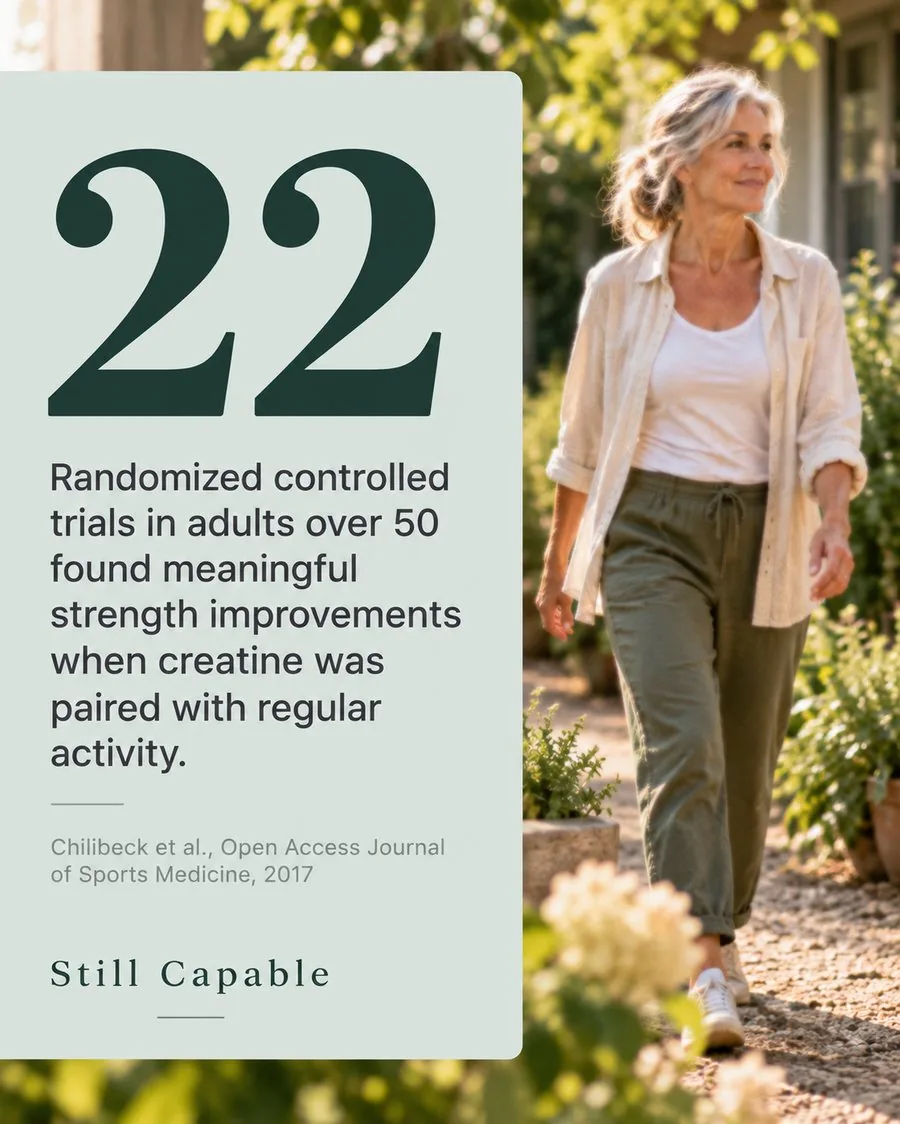
A 2025 review looked at 20 trials in adults over 55. Women made up 69% of the people in those trials. The review found meaningful gains in strength. The International Society of Sports Nutrition says creatine is not an anabolic steroid. It does not make women masculine. Creatine is also one of the most studied supplements in the world. The compound was never the problem. The label was.
My first reaction was 'creatine is for gym people, not me.' I'm a retired teacher. I garden, I walk, I carry groceries. I don't lift weights and I'm not interested in starting. What changed my mind was my doctor — she brought it up at my annual checkup before I'd even mentioned it. I figured if she wasn't worried about what it was, maybe I'd been wrong about it all along.
"But I Don't Lift Weights." Here's the Honest Answer — and Why It's Better News Than You Think.

This is the question that deserves a direct answer, because most supplement companies sidestep it. Does creatine do anything if you're not in a gym?
Here's the honest answer: creatine works best when you're also active. That's what the evidence shows. But what does "active" mean for someone with no interest in a gym? More than most people think. It's not about barbells. It's about any kind of load on your muscles. Carrying groceries. Climbing stairs. Getting up from the floor. A walk with hills. Some body-weight movement twice a week.
If you're doing any of that — and most women over 50 already are — the pairing the research describes is already part of your daily life. A company that tells you movement doesn't matter is setting you up to feel like the product failed. When the product was never the whole picture. That's what most of our competition has quietly decided not to say. We think it's the most important thing to say first.
What actually convinced me was the part about what 'resistance activity' really means. Carrying bags. Climbing stairs. Getting up and down in the garden. I've been doing that for years. Apparently that already counts. This didn't ask me to become someone I'm not — it just asked me to support what I was already doing.

No plan required. Full 365-day money-back guarantee.
Strength Has Two Halves. Almost Every Supplement on the Market Is Only Covering One of Them.

The supplement world has spent decades focused on one thing: what your body can do on a good day. But if you've been paying attention to your own body, you already know that's only half of it.
The other half is what doing things costs you. The day after a long walk. The Monday after a weekend of projects. The week after a few days off your normal routine. This part of your life doesn't show up in before-and-after photos. It doesn't get addressed in supplement ads. It has no fix on most shelves. Because the industry has been focused on what you can do — not on what doing it takes out of you.
Two separate experiences. Two different needs. The most honest thing a supplement can do isn't to promise you'll feel younger. It's to address both sides of what you're actually dealing with. With ingredients that each have their own real, proven role. And no miracle required.
What Magnesium Does — and Why Form, Dose, and Timing Matter.

Magnesium is one of the most talked-about supplements on the market. It is also used in many different ways. Many women over 50 already take some form of it. Some notice nothing. A smaller group says it even makes sleep worse.
The difference often comes down to three things: form, dose, and timing. Magnesium oxide is cheap and common in drugstore products. The body absorbs it poorly, so less of it gets where it is needed. Magnesium glycinate is magnesium joined to an amino acid called glycine. The body tends to absorb it more easily. It is also less likely to upset the stomach than some other forms.
What it can do in a daily routine: support normal muscle and nerve function. That's magnesium's most proven role. It may also support sleep quality. A 2025 study found that adults taking magnesium bisglycinate fell asleep faster than those who didn't. The effect is real. But this is not a sleeping pill. It won't treat insomnia. For someone who wants their evenings to feel more settled, the right form at the right dose is a smart addition.
If magnesium glycinate does not agree with you, you will often know within 10 to 14 days. That is one reason for the guarantee. One more thing matters: the number on the front may not show how much magnesium you get. A bottle may say "500 mg magnesium glycinate" but give only 70 mg of magnesium. Those are not the same amount. Check the magnesium amount on the label. It should be easy to find.
Two Jobs. One Routine. Here's Exactly What That Looks Like.
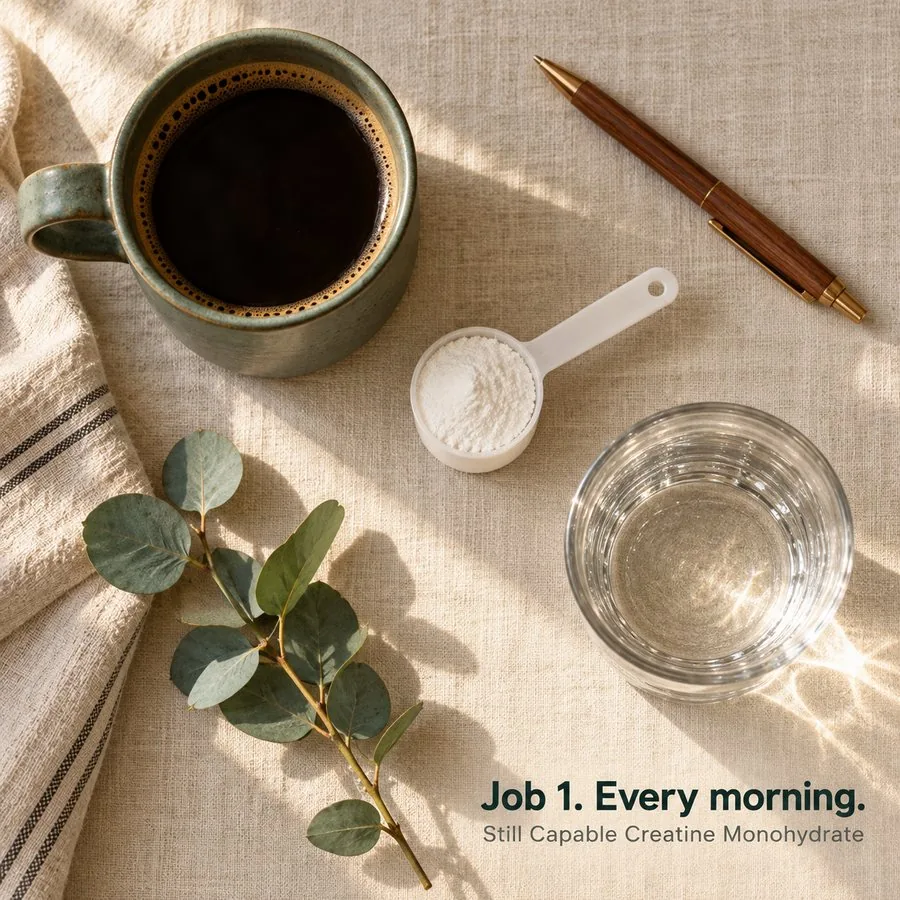
Here is what the two halves look like in real life. Still Capable is a two-part routine for women over 50 who want to keep relying on their bodies. No gym identity. No promise of youth. No miracle blend.
Two ingredients. Two times of day. Two separate jobs. This is not a proprietary blend. Not a chemical cycle. These two ingredients are not claimed to make each other work better. No study has tested them as a combination. What it is: a simple, well-dosed routine that covers both sides of what you're dealing with. Takes ten seconds twice a day. Nothing else changes.
Simple is the point. The woman who quits because a routine is too hard doesn't get results from any of it.
I have a drawer full of supplements I keep meaning to take and forget about. What made this different was two specific things at two specific times. One with my morning coffee, one before bed. Three months in and I haven't missed a day, which is completely unlike me. The simplicity is genuinely the thing that makes it work.

Three supply options. No plan required. Full 365-day guarantee.
What We Won't Claim — and Why That Should Actually Make You More Confident.
Most supplement companies hide their limits in the footnotes. We're putting ours front and center. Because we think it's the most important thing on this page.
We will not say these two ingredients work better together. No clinical trial has tested creatine and magnesium glycinate as one combined product. Each ingredient has its own evidence and its own job. There is no proven special effect from taking them together. We will not pretend there is.
We will not say this routine replaces movement. The best evidence for creatine in adults over 50 comes from people who also stay active. We would rather say that now than have you spend three months wondering why nothing changed.
A company that tells you what its product can't do is confident in what it can. Our main competitor hasn't said any of this. We're choosing to say it first.
Three Things Women Over 50 Almost Always Ask Before They Try This.
This is the most common concern. And the easiest one to address. Creatine can raise a molecule called creatinine in your blood. Your doctor checks creatinine to estimate how your kidneys are doing. So some women on creatine see a number they didn't expect on their blood test.
Here's what happens. This rise can be a lab effect, not a sign of kidney harm. A 2025 meta-analysis found no significant change in glomerular filtration rate, or GFR. GFR is a key measure of kidney function. Creatinine can rise because you take creatine, not because your kidneys are failing. Tell your doctor you take creatine before your next blood test. That's it. If you have kidney disease, ask your doctor before you start any new supplement.
Possibly, for some people. Creatine draws water into your muscle cells. Not under the skin — inside the muscle. For most women over 50, this is not noticeable. For some, the scale goes up a few pounds in the first week or two. This is not fat. It is not permanent. The question is whether it's worth it — more energy for daily activity in exchange for a few extra pounds on the scale for a few weeks. Most women decide it is.
This one matters most. It shapes whether you stay with a supplement long enough to know if it works. Here's the thing: creatine doesn't create a feeling. It doesn't tingle or buzz. What changes is quieter than that. A bit more energy on a given day. A little less cost to ordinary effort. A slightly faster bounce-back after a hard week.
Don't ask "do I feel different?" Instead, pick a simple test before you start. A number of sit-to-stand reps in 30 seconds. A familiar walk, and how you feel at the end. Repeat it at six weeks. Then at twelve. That's the honest way to know if it's working. We'll help you set it up when your order arrives.